Why Scrolling Before Bed Worsens Anxiety and Ruins Guided Sleep Meditation
Scrolling before bed feels harmless because your body is technically still. You’re under a blanket, maybe half yawning, maybe telling yourself you’re just checking one thing. But your nervous system doesn’t read that as rest. It reads novelty, comparison, stimulation, unfinished information, and sometimes straight-up threat. A doomy headline, an awkward text thread, someone else’s perfect vacation, a video designed to keep you watching for twenty more minutes — none of that tells the brain, “You’re safe now. Sleep.” It says, “Stay alert. More is coming.”
That’s why the link between anxiety and sleep is so stubborn at night. You’re tired enough to want rest, but mentally revved up in exactly the wrong way. The problem isn’t just the content being “bad.” Even neutral content can keep your brain in acquisition mode. It keeps scanning, sorting, judging, anticipating. Instead of letting the day close, scrolling stretches it out. Work follows you into bed. Social comparison follows you into bed. Other people’s urgency follows you into bed. Then you try guided sleep meditation and wonder why your mind keeps jumping tracks every five seconds. It’s not because meditation “isn’t working.” It’s because you walked into it carrying a whole digital crowd.
Why Guided Sleep Meditation Falls Flat After a Social Media Spiral
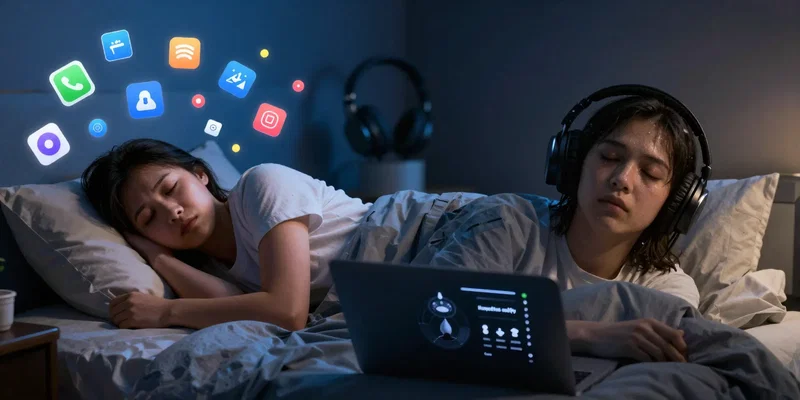
Guided sleep meditation asks your attention to do something very specific: narrow down, settle, and stay with one gentle thread long enough for the body to soften. That’s a completely different mental task than social media. Apps train attention to dart. Meditation asks attention to land. Apps reward interruption. Meditation depends on continuity. Apps feed little jolts of novelty. Meditation works through repetition, slowness, and predictability. They are almost opposites.
So if you move straight from fast, bright, emotionally sticky content into a calming voice saying, “Notice your breath,” the switch can feel absurdly hard. Not because there’s anything wrong with you. Because your brain has momentum. It’s like trying to coast into a parking spot after flooring the accelerator. A lot of people think they’re bad at meditation when the real issue is timing and sequence. Your guided meditation habits matter more than most people realize. If meditation becomes the very last thing you do after thirty minutes of reactive scrolling, it’s being forced to clean up a mess it didn’t make. Put another way: meditation is better at preventing nighttime spirals than rescuing you from one already in full swing. That’s a useful distinction, and it can save you from giving up on a tool that actually works when you stop sabotaging it first.
The Hidden Cost of “Just a Few Minutes” on Your Evening Stress Levels
The bedtime scroll lies about time. Five minutes turns into twenty because the entire system is built to erase stopping points. There’s no natural ending, no closing chapter, no cue that says, “You’re done now.” That matters more at night than during the day because your brain is already depleted. Decision fatigue is high. Emotional resilience is lower. Whatever you see lands harder. A mildly irritating post at 2 p.m. becomes a full internal monologue at 11:30 p.m. A work message becomes a stress loop. A health story becomes a symptom search. A random video becomes an hour gone.
And then there’s the physical piece. Blue light gets discussed a lot, and yes, it can interfere with melatonin. But plenty of people focus so much on light that they miss the bigger issue: cognitive arousal. You can dim your screen, switch on night mode, and still stay mentally wired. If your last half hour awake is filled with stimulation, your body pays for it. Heart rate may stay elevated. Muscles stay subtly braced. Thoughts stay busy. Sleep becomes lighter, more fractured, and less restorative. That’s why anxiety and sleep problems often feed each other so neatly. You go to bed tense, sleep poorly, wake up more fragile, then crave more distraction the next night. The habit starts looking normal because it’s common, but common doesn’t mean harmless.
A Digital Detox Before Bed Doesn’t Need to Be Extreme to Work
The phrase digital detox can sound a little dramatic, like you need to disappear into the woods and swear off technology forever. You don’t. What actually helps is simpler and much less annoying: create friction between you and the nighttime scroll. Charge your phone across the room. Put your meditation app on a separate device if you can, or queue it up before your cutoff time so you’re not opening the phone and getting pulled into everything else. Turn off nonessential notifications after a certain hour. Remove the apps that are hardest to leave from your home screen. Tiny barriers matter at night because tired brains usually take the easiest path.
A useful rule is this: don’t make your bed the place where input keeps happening. Make it the place where input stops. That might mean giving yourself a 20- to 30-minute buffer between the last scroll and lights out. Not as punishment. As decompression. During that buffer, keep things boring in the best possible way: wash your face, stretch for three minutes, read two pages of something low-stakes, listen to quiet audio, write down tomorrow’s loose ends so they stop circling. The goal isn’t to become a wellness monk. It’s to stop handing your nervous system fresh material right before asking it to power down. Once you feel the difference for a few nights, the “I deserve some screen time” argument starts losing a lot of its charm.
How to Build Guided Meditation Habits That Actually Calm You Down
If guided sleep meditation keeps getting derailed, adjust the routine around it instead of blaming the meditation itself. Start earlier than you think you need to. Ten minutes before you’re fully exhausted is usually better than waiting until you’re already overstimulated and cranky. Pick one or two recordings you genuinely like and stick with them for a while. Familiarity helps. A new teacher, new script, or new app every night can become just another form of novelty chasing. The ideal sleep meditation is not the most profound one. It’s the one that lowers friction and feels easy to return to when your attention wanders.
It also helps to stop using meditation as a performance test. You do not need to “clear your mind.” You do not need to stay perfectly focused. You definitely do not need to become deeply serene on command. The win is smaller and more realistic: you gave your mind one quiet place to come back to instead of fifty noisy ones to bounce between. If thoughts keep coming, fine. Let the voice be the main thing, not the only thing. Over time, guided meditation habits work because they become a cue. Same time, same tone, same sequence. Your brain starts recognizing it as part of shutting down. Pair that with less scrolling before bed and the effect is much stronger. Not magical. Just solid. You’re no longer asking meditation to fight a screen-induced adrenaline drip. You’re finally giving it a fair shot.
The Best Bedtime Routine for Anxious Nights Is Usually the Least Stimulating One
When people are anxious, they often reach for more input because silence feels uncomfortable. That makes sense in the moment. Scrolling gives the illusion of relief because it distracts you from your own thoughts. But distraction is not the same as downshifting. If you want sleep to come easier, your bedtime routine has to get quieter, not more crowded. Less emotional charge. Less unpredictability. Less temptation to react. The right evening routine is not necessarily the prettiest one from the internet. It’s the one your nervous system trusts.
For most people, that means a short repeatable sequence: stop scrolling, dim the room, do one or two basic physical cues that signal the day is over, then use guided sleep meditation as the bridge into sleep rather than the emergency cleanup crew. Keep it plain. Keep it repeatable. Keep it a little boring. That’s not a flaw. Boring is often what peace feels like when you’ve been overstimulated for twelve straight hours. And if you’ve been wondering why your meditation feels weak while your mind feels loud, this is usually the missing piece: the hour before bed matters more than the five minutes after your head hits the pillow.